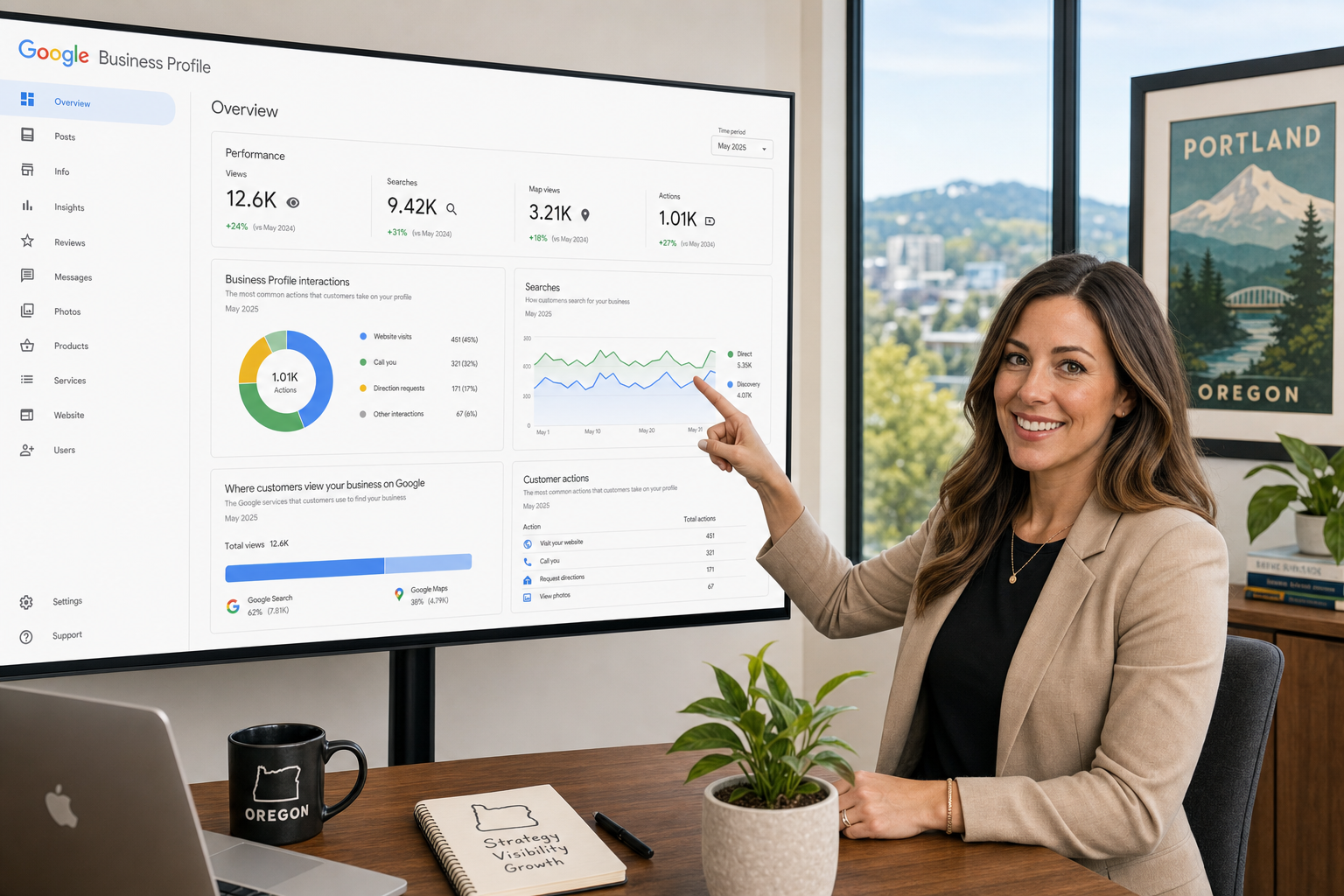
Every Google Business Profile in Oregon is a public window into how a competitor is positioning themselves in local search — and most business owners never look through it deliberately. A structured review of competitor profiles, done consistently, tells you who is investing in their local presence, what they are communicating to potential customers, and where your own profile stands relative to the field. It requires no paid tools, no special access, and very little time once you know what to look for.
Why Google Business Profiles Are a Competitive Intelligence Source
When a customer searches for a local service in Oregon — a plumber in Eugene, a bookkeeper in Bend, a web designer in Portland — the Google map pack is the first thing they see. The three businesses that appear there have earned their position through a combination of relevance, proximity, and what Google calls "prominence," which is largely built through profile completeness, review activity, and engagement signals.
Every element of a competitor's profile that helped them earn that position is visible to you. You can see their categories, their review count and rating, their photos, their posts, their Q&A section, and their service descriptions. You can observe whether they have been actively managing the profile or letting it sit static. That combination of signals tells you what the bar looks like in your market — and where you have room to meet or exceed it.
What to Examine in a Competitor's Profile
A thorough review of a competitor's Google Business Profile covers several layers. Work through these systematically rather than scanning casually:
- Primary and secondary categories: Google allows businesses to set one primary category and several secondary ones. Competitors who have chosen their categories carefully — selecting the most specific, accurate terms rather than defaulting to broad ones — tend to rank better for niche queries. Note what categories they use and compare them to your own selections.
- Review count, average rating, and velocity: How many reviews has the business accumulated, what is their average rating, and when did the most recent batch arrive? A business generating a steady flow of new reviews is actively asking for them. A business with a high count but nothing recent may have let their review process lapse.
- Owner responses: Scroll through recent reviews and look at whether the owner responds, how quickly, and with what tone. Thoughtful responses to both positive and critical reviews signal active management. No responses at all is a gap a competitor has left open.
- Photo count and recency: How many photos does the profile have, and when were the most recent ones uploaded? Google favors profiles with regular photo activity. A competitor with hundreds of photos uploaded over several years but nothing in recent months has let this signal weaken.
- Google Posts: Check the Updates or Posts section. Some businesses post regularly — sharing service updates, seasonal promotions, or relevant information. This is an underused feature that adds content freshness and can drive direct actions from the profile.
- Q&A section: Many profiles have questions that customers have asked, sometimes answered by the owner and sometimes left unanswered or answered only by other users. A competitor who proactively populates their Q&A with useful answers has built an advantage in the profile that most of their competitors have not matched.
- Service menu and descriptions: Well-optimized profiles describe their services in detail. Sparse service sections leave Google less information to work with when determining relevance for specific queries.
Francisco Labs audits Google Business Profiles for Oregon businesses and builds the optimization plan that closes the gap between your current standing and the top competitors in your market. If your profile is not performing the way it should, let's take a look together.
Turning Profile Observations Into Action
The goal of reviewing competitor profiles is not simply to understand what they are doing — it is to identify specific actions you can take on your own profile. A few patterns that translate directly into improvements:
If a top-ranked competitor has a significantly higher review count than you, the gap is rarely about customer satisfaction. It is almost always about whether you have a systematic process for asking satisfied customers to leave a review. Building that process — a follow-up message, a direct link to your profile, a brief ask after a completed job — is often the single highest-leverage action a local Oregon business can take for their map pack ranking.
If competitors have detailed service descriptions and yours are sparse or missing, adding specific, keyword-relevant descriptions for each service you offer gives Google more to work with when matching your profile to search queries. This is a one-time investment with lasting value.
If a competitor is active on Posts and you have never used the feature, starting a regular cadence of one or two posts per month keeps your profile fresh and gives potential customers a reason to engage with it beyond just checking your hours and reviews.
Setting Up a Simple Monitoring Routine
Competitor profiles change over time. A business that was behind you in review count six months ago may have run a review campaign and surpassed you. A new competitor may have entered the map pack. A previously strong competitor may have let their profile go stale.
A monthly check of the top three to five competitors in your primary local search category takes about fifteen minutes and keeps you aware of shifts in your competitive environment. The key data points to record each time are: map pack position, review count, most recent review date, and any new features or content the competitor has added.
Over a few months, this record becomes genuinely useful. You can see which competitors are actively investing in their local presence, which are coasting, and whether your own profile improvements are translating into position changes. For Oregon small businesses competing in markets from Portland to Bend to the southern valley, this kind of deliberate, ongoing attention to the competitive landscape is what separates businesses that show up reliably in local search from those that are effectively invisible to the customers searching for exactly what they offer.
Ready to improve your local map pack ranking?
Francisco Labs optimizes Google Business Profiles for Oregon small businesses — from initial setup and category selection to ongoing review strategy and content. Let's build a profile that ranks and converts.
Start a Project